App Development Life Cycle

Understand the nuances of App Development Process.

We create wonderful app experiences

Design - UI/UX are important components of successful apps.

We specialize in iOS app development

iOS apps have greater engagement and In-App purchases.

What do you need to augment your business?

Do you need a Mobile App OR Mobile Website?

Creative App Marketing Strategy

Get your app some great visibility on the App store.

Monday, June 24, 2013

Tablets Vs. Smartphones

How Would You Like to Shop in the Future?

According to a Forrester report, “Mobile commerce is expected to grow.”

Before reading further, here are some jaw-dropping stats on Mobile Commerce:
- By 2016, the average American is expected to spend $1,738 online per year
- Mobile commerce revenue is expected to rise to $31 billion by the year 2016 [Forrester report]
- Online sales are expected to see a 162% increase by 2016
- Four out of five US smartphone owners, use phone to help with shopping [Google/Ipsos]
- 60% of tablet owners have purchased goods using a tablet

Smartphones and tablets have taken their place as the third and fourth screen after TV and desktop, in the consumers lives. The increasing number of tablet and smartphone owners in the U.S. is changing the way people shop.

According to a study, "The Future of Mobile News,” 22% adults in the US owns a tablet and 44% of U.S adults own a smartphone device.[Fig.1]
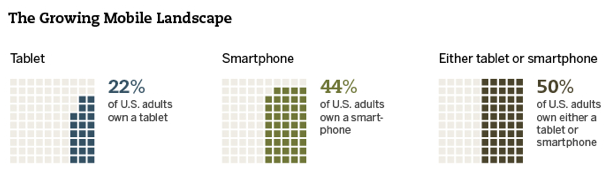
Fig.1
The number of smartphone users is expected to grow to 101.5 million in 2014 from 93.5 million in 2013. Whereas, the number of people using tablet devices is expected to rise to 89.5 million in 2014 from 75.6 million in 2013. The rate of change in the tablet users is much higher i.e. 18.3% as compared to the rate of change in smartphone users (7.9%).[Reference Fig. 2 & 3]

Fig. 2

Fig. 3
Users spent more time and money when they are shopping online. According to a recent research by eMarketer, “Mobile shoppers spend a surprising amount when using these devices — an average of $329 per order when on tablets and $250 when on phones.” Tablet devices are generating more revenue as compared to that of smartphone devices.

In fig. 4, the research clearly shows that tablet users buy products on their devices only, whereas, smartphone users make the purchase offline, i.e. either they visit the store and buy the product or they research more on their tablets before they buy.

Fig. 4
Though the number of smartphone users is more than the tablet users, tablets are contributing more towards the online conversions. People are more active on their tablet devices than smartphones. [Source : 3dcart]

Fig. 5
Mobile owners use their devices to shop, especially tablet owners who power couch commerce. Tablet owners are three times more likely to purchase than smartphone owners.

Fig. 6
Smartphones and tablets seem to have a strong hold on the retail sector; people use both devices differently while shopping. This makes it important for marketers to create different marketing strategies for both the mobile devices, a one-size fits all approach won’t work. According to a Forrester analyst, “marketers are making a big mistake if they lump the two together.”

Smartphone and tablet users have unique preferences, for instance, “Tablets are primarily used at home for consuming media, online shopping, and viewing along with TV, whereas, Smartphones are used on-the-go and at home for communication,” [Forrester Research Report]. The report also found that 75% of mobile consumers use smartphones while shopping in stores; only 8% use tablets. Mobile marketers can use these consumer habits to create better campaigns for better results.

So, do you need a tablet app or mobile app for your online retail business? To know more on the topic, keep a track on the next publication.

For more information on tablet app development and marketing strategy send in your email to marketing@ymedialabs.com


Tuesday, June 4, 2013

Mobile Social Media Marketing

How to Take Advantage of This Growing Convergence

According to IDC, roughly half of the US population owned smartphones at the end of 2012. This population is expected to expand to 222.4 million smartphone users, or about two-thirds of the US population by 2017. Of the huge amount of the population currently using smartphones, 80% of respondents reported reaching for their phones within 15 minutes of waking. And about four out of five respondents have their phones on hand all day, except for about two hours.

Another research report from eMarketer states that, “more than 50% of all the people on Twitter and Facebook are accessing these social platforms using their mobile devices.”

Mobile + social = Brand Awareness, Customer Engagement

Mobile and social media are proving to be a great combination for the marketers. Mobile devices have empowered the users to access social media sites whenever and wherever they want. This has come forward as a great opportunity for the marketers to pull in new users by sharing their valuable information on the social media platforms. Brands that are heavily dependent on social media marketing can take advantage of this convergence by creating a mobile-specific marketing strategy.

Before proceeding further on how to take advantage of this growing convergence, let’s gather some market stats on the number of smartphone users and Top social networks.

Fig.1
According to ComScore’s key insights from the 2013 Mobile Future in Focus, “The U.S. smartphone market has surpassed 50 percent market penetration. The number of smartphone subscribers has increased 29 percent from a year ago and 99 percent from two years ago (fig.1).”

In 2013 smartphones are projected to become the most common device used to access the social media platforms. Figure 2 shows more and more people are using their smartphone devices for their daily dose of news and information. Whether they are waiting for their turn in the doctor’s clinic or are commuting to their work place, they are constantly using their smartphones to access social networking sites like Facebook, Twitter and Linkedin.
Fig.2
According to Nielsen’s new report, “Mobile devices and mobile apps are the driving force behind the growth of social media in the US.” Nearly a third of the time spent on social media sites is via mobile devices, Nielson researchers concluded. Nearly forty percent of the users spend their time on socializing via their smartphone devices. Facebook and Twitter are the most popular sites among the users and the number of people using the social networking sites is increasing every year. [Reference fig. 3]
Fig.3
The growth of smartphones has increased exponentially. And people are using these mobile devices largely for social media. The number of mobile phone users is increasing every year (fig. 4). Marketers can take advantage of this growing trend of using social media on the mobile devices.
Fig.4
How to take advantage of this growing convergence

Every marketer looks for maximum customer engagement and brand awareness among a huge number of publics. And for this you must chalk out a clear plan on how social media can help you in driving the audience growth.

Communicating with mobile social media users is not difficult. Here are few tips that you can work on while structuring your mobile marketing strategy:

1. Facebook, A perfect social media platform to target people from various age-group, gender or location: A study conducted by IDC on US respondents between 18 and 44 shows that Facebook is the most [Fig.5] preferred activity on a smartphone after sending or receiving emails. 70% of respondents use Facebook on their phone, and 61% use it every day. User engagement on FB is highest over the weekend, starting on Friday and peaking on Sunday. Also, the social media channel dominates other social networking sites i.e. Twitter and LinkedIn.
Fig.5
It shows that Facebook has the huge potential for your marketing strategies. You can target a specific group of audience based on your business requirements and other factors. For instance, if you are offering summer apparels or accessories for girls aged n 20-40, you can locate your audience, their age-group and keep them posted about your business details. Facebook gives you the options to interact with your audience on one-to-one basis. You can send personal messages, chat with them and even get to know about their liking or disliking on certain products.

2. Smartphones gave birth to Location-based marketing: According to Facebook’s Chief Operating Officer, Sheryl Sandberg, 42 Million users claimed Facebook Offers in the 4th Quarter of 2012. Connecting with users by creating product/services pages is a great idea. People check their Facebook profiles several times in a day. Post offers, updates, achievements and more about your business. You have a high possibility of catching eyeballs on a lucrative offer.

You can also ask your customers to post check-ins on their internet connected mobile devices and offer them a thrilling deal or discount on your services. Check-ins are a great way of creating brand awareness. And you never know your coffee shop could also get some new customers on the same day as your customers’ friends can also visit your shop if they are nearby or the craving of having coffee grab them after checking their friends’ check-ins.

Post eye grabbing pictures of your products on social networking sites and start a contest by asking your followers to write about their favorite products from your brand. Recently, L’Oreal posted on Facebook, their celebrities pictures from Cannes Film Festival who used their products while making their appearance on the red carpet. On the same pictures they also displayed the detailed description of products used by these celebrities. The leading cosmetic brand also offered a set of their cosmetic products to their followers who shared their content on their profiles.

Local businesses can now include barcodes in their offers. Users love it as they just have to hold up their email voucher or mobile with barcode for a simple scan.

3. Ad Networks and Social Media Marketing:  According to Business Insider Intelligence estimates, mobile display advertising is on track to hit $3.2 billion in 2013.

Ad networks offer branding and direct response advertising across premium inventory on mobile publishers, operator portals and in applications including iPhone, Android and Blackberry. You can easily reach your target audiences with the help of these mobile ad networks.

4. Visual Social Media – A new way to share and discover stories: Instagram, Pinterest are becoming popular platforms where brands are promoting their products. Both the social media platforms are popular among users who access these platforms from their smartphones and reshare, retweet or pin the pictures that they like. According to a report from Simply Measured, “Luxury and apparel brands have found the most success on Instagram. Six of the top ten Interbrand 100 companies on Instagram are in these verticals.”

A new survey by Digitas and Curalate revealed that approximately 70% of brand engagement on Pinterest is generated by users.

Capitalize on visual social media popularity by sharing your content laced with the product information with millions of users, and let them actively engage with your products and services.

For more information on app development and marketing strategy send in your email to marketing@ymedialabs.com

Monday, June 3, 2013

How Does Social Media Influence Buyers Decisions

Social Shopping : Click, Read, Share, Review & Buy

Are you planning to buy a service or product soon? Do you ……

- Like to take a second opinion from customers who have already used a specific product or service?
- Follow social media just to know about what’s hot and trending?

If you really do all these then keep reading the post

There are many who love to use social media to garner information and share their experiences with others. This has made ‘social shopping’ a common phenomenon a part of the agile marketing. Users are taking advantage of this medium to gain insight on a product or service before making any decision for usage (purchase). The journey of a user from ZMOT to SMOT has changed due to the unlimited potential of Social Media.
Fig. 1
Facebook, among all the social media sites boasts of 955 million active users and where 255 million photos are uploaded every week [Businessinsider].

Social media marketing is getting hotter with every passing day. It’s not only the users but the Brands are conscious of their Goodwill, Brand Value in these platforms. They too, like to share their products info online and encourage their customers to do so on their social networking profiles to enhance visibility of their products or services. Many of the Facebook users are responding to the brands’ marketing efforts on Facebook by interaction through ‘liking’ their page to get status updates or converse on the pros and cons about the product or service. For instance, Coca cola Facebook page has nearly 66 million likes and over 1 million people are actively talking about them [Facebook].

Fig. 2
The amalgamation of tablets and smartphones with social media has further enhanced the users’ online shopping experience. However, tablets are the most preferred device for online shopping, as 46% of the online shoppers prefer using their tablets for reading reviews on social networking sites.


Fig. 3
Figure 3 describes the way social media sites are being used by the tech-savvy customers of the world. Nearly two-thirds use social channels to read consumer feedback and find product information, and nearly one-half use such channels for professional networking [NMincite]:
• 66% read consumers reviews
• 54% share positive feedback
• 50% share negative feedback
• 60% find information on products and services
• 58% find promos and coupons
• 48% use social media for career networking
• 28% do so to find jobs

Many of the brands are endorsing their products with popular celebrities, who have huge fan following on the screen and social media as well. Many brands associate themselves with film festivals or sports tournaments to promote their products easily to a huge number of fans. Facebook, Pinterest and Twitter are the leading social networking sites where brands share pictures of their real life instances, such as, press conferences, live shows, concerts etc. (reference Fig. 4)
Fig. 4
Marketers create polls on LinkedIn to get real time results to know behind-the-scenes look at what people are saying. Company-branded groups are formed to discuss about the industry. Status update field is used to make company announcements, offer special deals, give tips and share links. For instance, in figure 5, the Walmart’s Linkedin page shows the number of followers and likes on the status they shared on their profile.
Fig. 5
Figure 6 shows how marketers use social networking sites for promoting their products. Creating pages on social media sites and posting messages on those pages is the most preferred way to reach audience.

Fig. 6
Users, too, interact with marketers on social media by liking or commenting on their promotions. Figure 7 shows how shoppers interact with retailers and make a final decision to buy products on various social media sites. Customers used retailers’ Facebook links to buy products. Retailer blogs and Twitter are the primary sources from where customers get information to buy these products. Customers also post comments on retailers’ Facebook, blog and Twitter accounts and blog (76%) are at the top where the most customers prefer to post their comments.
Fig. 7
Social media marketing is benefitting both the marketers and the consumers. It’s a two-way process. Marketers offer their products for free at times, but demand attention by asking the users to promote the products to as many people on social media sites as they can.  Social media users participate in contests, quizzes, giveaways initiated by the marketers to win the prizes. Products like; cosmetics, jewelry, clothes etc. are exhibited in a very glamorous way that users just can’t resist to buy.

Fig. 8 shows how Levi’s, a leading apparel brand, created their web-page to communicate with their audience.
Fig. 8

Social Shopping is gaining strength. Everything is being shared on these platforms. Prices are being fixed in the comment threads in many cases. People like the product, ask for price and contact the seller for further details.

Are you ready to dive in the sea of “Social Shopping” and experience a whole new approach of shopping in the tech world?

For more information on app development and marketing strategy send in your email to marketing@ymedialabs.com


Wednesday, May 15, 2013

Scribbly App

Scribbly App – New Way of Facebook Communication for Free

Scribbly is a free app that lets you chat with friends on Facebook by using text and hand-drawings. Connect with your friends on Facebook and send hand drawn images or pre-installed emoticons.

Show your emotions to your friends, families or colleagues in a different way. Use hand drawn images or edit existing images in your gallery. Take a picture and insert your emotions. Scribbly is your new way of connecting.

The best thing about Scribbly is you can write and draw and share the same with your Facebook friends in real time.

Whether you want to play Tic-Tac-Toe or tease your friends by making those amusing faces or by drawing on the snaps, Scribbly adds the spark in your chat and make your time special with your friends.

App Description:

Scribbly, an IM application is developed by Y Media Labs for iOS 5 and above.

Using Scribbly is very easy. Find friends who have Scribbly on their iOS device or invite them. Tap on the toggle switch and start a conversation by saying “Hi” in a new style. Use the color pallet for drawing or you can pick from the hand drawn scribblies available in the app. You can also click a picture or use a photo from the gallery and modify it in your style to show your artistic skills. Guess what? You can save your Scribblies!!


Scribbly for iPhone and iPod Touch includes;
-   A canvas to draw scribbles
-   A color pallet and eraser
- Easy and fun to use hand drawn templates
- Take a picture and put in your hand written messages
- Use pictures from gallery and put in your own thoughts
- Send Invites to your friends directly from the app
- Save the received or sent scribblies and reuse them

Requirements: Compatible with iPhone 3GS, iPhone 4, iPhone 4S, iPhone 5, iPod touch (3rd generation), iPod touch (4th generation), iPod touch (5th generation) and iPad. Requires iOS 5.0 or later. This app is optimized for iPhone 5.

The app can be downloaded from the App Store at https://itunes.apple.com/in/app/scribbly/id642764159?mt=8

For more information on app development and marketing strategy send in your email to marketing@ymedialabs.com

Wednesday, May 8, 2013

App Discovery

What Are The Top Sources to Find Apps?

Before searching the preferred sources of users to find apps, let’s have a look on the current scenario of the app store, i.e. number of apps available and downloaded by the users:


GROWTH STORY

App stores are bubbling with the number of apps. And it’s not just about the number of apps available in the app store; users are equally interested in exploring and buying the apps from the app stores.

The recent App Interrogator research note from Research firm Canalys states, “The app industry for mobile devices is now a maturing market, and shows healthy growth for the download and purchase of apps on mobile devices.”

App market has grown exponentially over the years. For instance, the number of apps available on the app store as well as the number of downloads by users is increasing every year, see figure 1.

As per the reports of Statista, a statistics company, “As of early 2013, 40 billion apps were downloaded from the App Store, games being the top category.”

Games apps were at the top place with 16.77% share whereas, education apps were the second-most popular category, with a share of 10.55 percent of all apps being learning apps. Figure 2 shows the most popular categories of apps that generate the maximum number of downloads.

What are the primary sources for searching the apps in various categories?

From general browsing on app store to reading blogs and ads in TV, Radio and Newspapers, users rely on number of sources to download apps on their devices

In figure 3, a number of sources are listed from where the users learn about the apps and how much preferences they give to a particular source. A huge number (63%) of the iOS users rely on general browsing on the app store, whereas for Android Apps, 58 % used the same channel to learn more about the apps. The percentage of users searching for an app on the search engine (Google) is very less i.e. 14% and 16 % for iOS and Android respectively.

50% of the iOS users get to know about an app from their family members or friends.

In 2011, Nielsen conducted a survey on, “Where do downloaders say they learn about apps?” The graph here shows the difference between the users’ sources to find apps then and now.

As per the survey reports, 63% of iOS and Android users rely on searching the app store, whereas, now the number of Android users using the play store search has reduced to 58%.  iOS and Android users seeking recommendations from friends and family members have also reduced to 50% and 41% as compared to 53% and 61% in 2011 respectively.

Users for both the smartphones platforms rely more on browsing the “top-rated” or “most popular” categories on the app store, which was not available in 2011 (Check figure 4).


Focus areas of developers

A huge number of apps are being launched on the app stores every day. At an average rate of 13,000 new apps are being approved every month since the launch of app store. How developers and marketers get their apps to rise above their competitors? How to target the right set of users? These are two focus areas of developers who want their apps on the top of the app store.


There are several sources that lead users to the app stores. One of the most important is getting listed in the Top 25 or the most popular categories in the app stores. It is clear from the figure 1 that Top 25 lists in the stores play a major role in most users' purchase decisions.

How to target the top 25 charts? Or How to get your app high exposure in the app store?

We have written two separate posts on the techniques on how reach the top of the app store and stay there? Click on the links to know more about the techniques to market your app on the app stores.

For more information on app development and marketing strategy send in your email to marketing@ymedialabs.com


Tuesday, May 7, 2013

Enterprise Mobility

Enterprise Mobility: Is It The Next Big Thing?

“In a time of rapid change, standing still is the most dangerous course of action”

In an era of an always connected workforce, the enterprises are marching ahead in leveraging the mobile technology innovations to stay connected. Everyone, right from the CEOs office to the shop floor wants immediate access to everything on any device, all the time from everywhere. The innovations in the Mobile app industry are driven by the consumer demands (for new creative apps), who are much more aware and smarter than before when it comes to using the latest technology to make their lives easy.

In short, Enterprise mobility is the ability of an enterprise to connect to people and access information all the time from any location.

As per Gartner’s report on latest smart device projection from 2012 to 2017, the projected growth for Tablet shipments is 69.8% year over year from 2012-2013 i.e. 116 M units to 197M units. Overall, the total smart devices shipment grows from 2.2 billion units to 2.4 billion units, a 9% growth year over year.


 The figures above are a clear indication that with the proliferation of the smart devices at such a fast rate, enterprise mobility is the next big thing.

As per the latest Gartner report (released on May 1, 2013), it was quoted that “Rolling out applications throughout the workforce presents myriad new opportunities beyond traditional mobile email and communications.” Thus, enterprise mobility provides an opportunity for more innovations in the mobile app development arena. A few examples of such applications are time sheets, employee self-service HR application, product configuration application, sales analysis tool and global conferencing applications.

Considering the proliferation of smart devices, changing demands of the employees for more flexibility and ease to work and the mission of the employers to make the workplace a better place to work for, the enterprises are allocating  a good percentage of their IT spends on enterprise mobility.

As per the Nasscom – Deloitte joint study on “Enterprise mobility,” the IT spend on Enterprise mobility is expected to double from 5% to 10-12% by 2020.  The report also suggests that the global enterprise mobility market will be USD 140 billion by 2010, growing at a CAGR (compound annual rate growth) of 15% with APAC showing the highest growth of 21 percent.

Benefits of Mobility

Based on the study conducted by CompTia on 437 end-user companies, the following can be attributed for the increase in adoption of mobility in the enterprise segment:

a) Productivity gains : Employees can access work related applications, tools, emails, office data anywhere, anytime on the move  and now  executing business does not require them to be available at workplace with their work stations on working days . This leads to employee efficiency.  62% of the companies attribute this factor for adoption of Enterprise mobility as against 56% last year.

b) Support telecommuting / remote work: One does not necessarily need to be in office to attend important meetings or be close to the server rooms to access the servers. All this can be done remotely and this offer much more flexibility to the employees.

c) Cost savings: With the real estate costs soaring high, policies such as BYOD help to save cost. In roles like sales and marketing, where it is critical to provide data at the right time at the right place, investing in enterprise mobility is a good return on investment for enterprises. 47% of the end users companies have adopted mobility for cost savings as against 35 % last year.

d) Business continuity planning: 46 % of Enterprises against 33% last year are of the opinion that they need to stay at par with what is latest in the industry in order to sustain itself. Therefore, to maintain the continuity of business, and be easy to work with, it is mandatory for enterprises to adopt latest technology

e) Create new cutting edge opportunity: The field opens a plethora of opportunities for the Mobile App development, UI development, consulting, and system integration and managed services which, in turn, will add to the revenues of enterprises.

f) Retain top talent: 25 % of the enterprises feel that they need to adopt the mobility to retain their top talent since top talent is always on the look to explore and they work on something which would create a difference to the world. Therefore, providing them comfort while accessing information and with new tools will help them to focus more on the job which would, in turn, be beneficial for the company.

For more information on iPhone app development and marketing strategy send in your email to marketing@ymedialabs.com

Customer Engagement with Augmented Reality

Augmented Reality: The most sought-after trend in marketing in 2013

According to market research firm Canalys’ latest App Interrogator research, “App downloads from four of the major app marketplaces (Apple’s App Store, Google Play, the Windows Phone Store and BlackBerry World) were up 11% in Q1 2013 as compared to all of Q4 2012.” The report also revealed these four stores combined had 13.4 billion downloads, and $2.2 billion in revenue.

The combined revenue curve of the four leading stores is also showing an upward trend with a growth of 9% in the first quarter of 2013, over the whole year 2012.

The above stats clearly demonstrate that users are connecting with brands and mobile apps are a good way to keep them engaged for better results. According to Adam Daum, Canalys’ chief analyst, “Apps have a huge impact on consumers, which have now become a central point to know how they engage with content and connected services.” Higher the consumer engagement, better the performance in the app store.

So the question is how to engage the users and keep them hooked with the brand? What will be the most sought-after trend which will help marketers in reaching the goal of constant engagement in 2013?

Before answering these questions, let’s have a look on the current scenario of app stores.
All the leading app stores are over-crowded with apps, for instance, there are 800,000+ apps on Apple App Store, 700,000+ on Google Play Store and 100,000 + apps on Blackberry and Windows app stores. With these numbers constantly increasing, almost all the categories are overly crowded with apps. It has become imperative for the brands to create apps with a different approach and mindset.

Role of Augmented Reality

According to a report from Juniper Research, Augmented Reality (AR) will be the retailers’ favorite in 2013 and will emerge as a new way of customer engagement. However, the traditional pay-per-download payment model will generate maximum revenue; AR is expected to scale the heights.

The research report state that augmented reality in marketing across mobile applications will generate 1.4 billion downloads by 2015, as an increasing number of brands familiarize themselves with the technology and its possibilities.

Augmented Reality is around for quite some time now; however, its real potential is yet to be realized by the marketers. Augmented reality (AR) is the integration of digital information with live video and the user's environment in real time. It identifies visuals to blend new information and displays the virtual result. It all happens in real-time creating amazing experiences for the users. Devices like, phone cameras, GPS devices are used to engage with consumers in a manner which no other medium can provide. AR apps and devices (engage users in their actual surroundings, thus, making them aware and providing more information. There are many AR apps which are thrilling the users and help the marketers in keeping them engaged with their businesses.

Yelp's Monocle is the first iPhone App with augmented reality. The app makes use of your camera when you are out on a street or driving. The app shows you the names of restaurants and bars. The users get reviews, store hours and all the other pertinent data Yelp has been known to provide.

TwittARound is another app for the iPhone 3GS that uses the GPS, compass and camera to show where Tweets are coming from and are overlaid onto the landscape, augmenting users’ view of the world and allowing them to actually see where the tweets are coming from and how far away they are.

Many retailers are looking at it as an effective and efficient advertising tool to improve customer engagement and interaction. Besides, the new technology can be used in various other sphere of business. For instance;

Realtors can show their clients apartments in different designs and colors as per their requirement. It will save their time in visiting the place again and again. They have to visit the place only if they like it on their phone.

Buyers can take a quick look at all the products available in a supermarket store. With one click from your phone’s camera, an app can instantly capture the store displays and provide you with all the information about the products. You can find the product with best reviews or you can sort by price for the best deal, much like you can do online.

Google Glass, Nokia City Lens (exclusive to its Lumia suite of devices), Innovega’s Augmented Reality contact lens are going to be some of the most sought after devices in the year.

For more information on iPhone app development and marketing strategy send in your email to marketing@ymedialabs.com